What the software does
Appointments and schedule
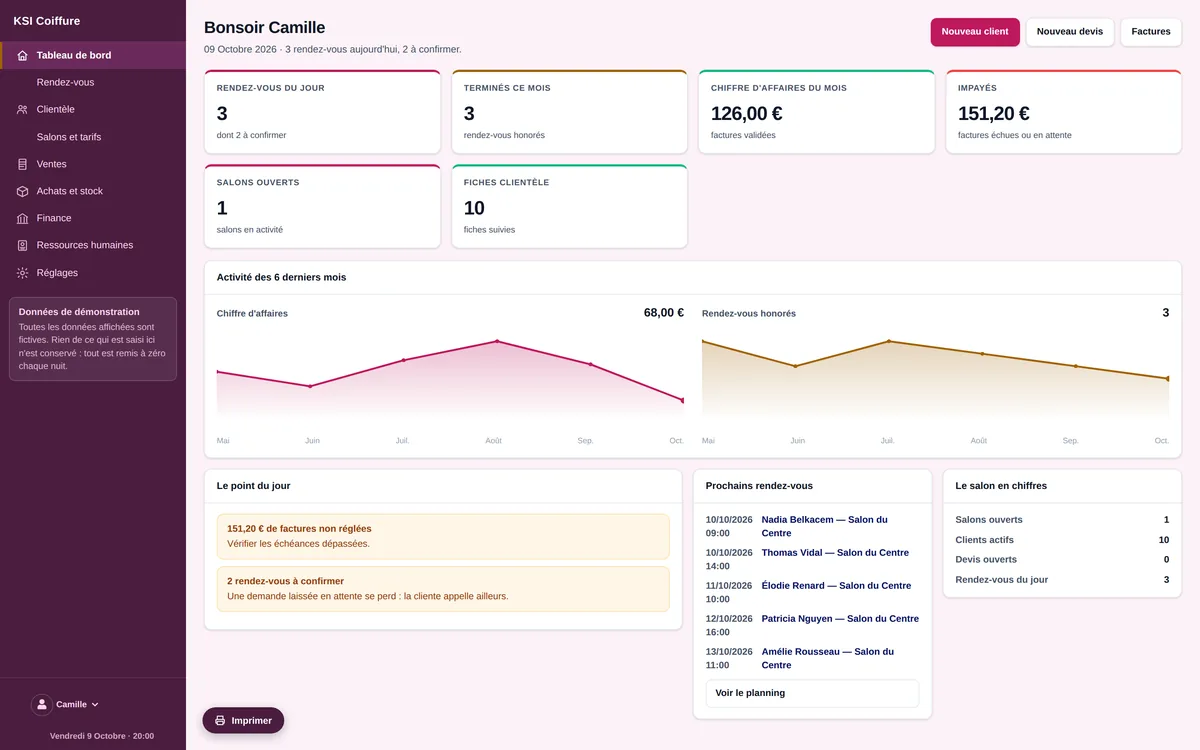
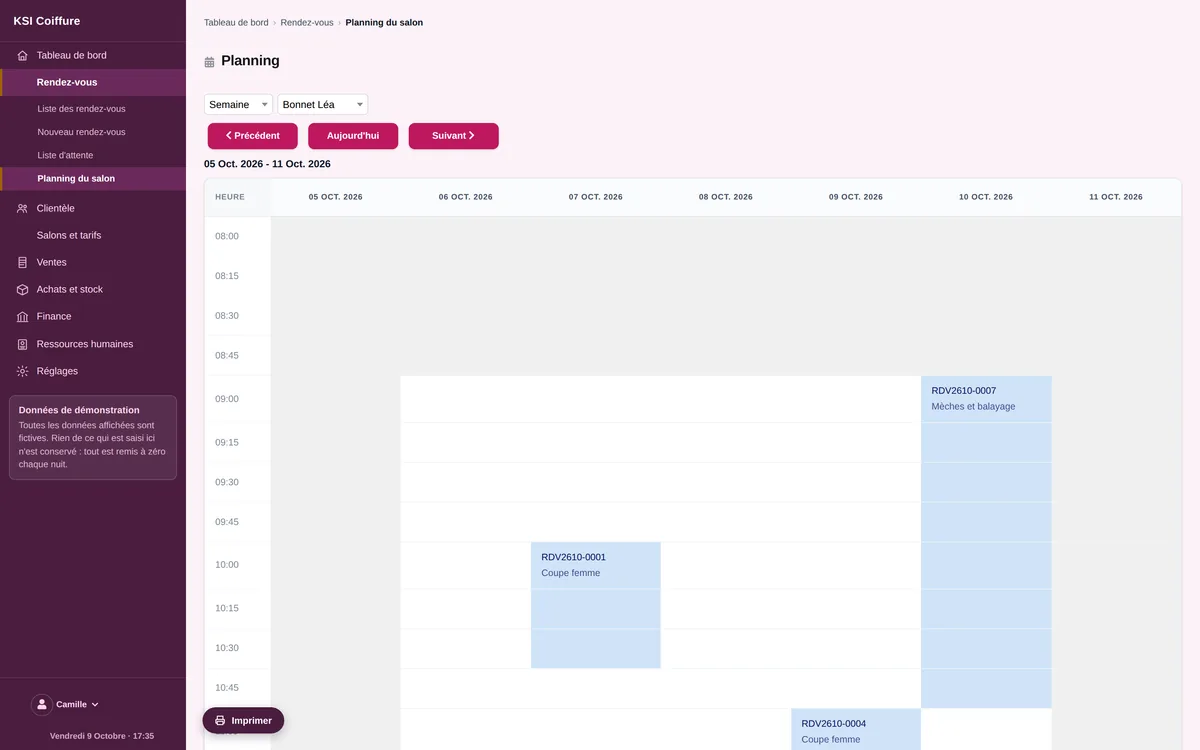
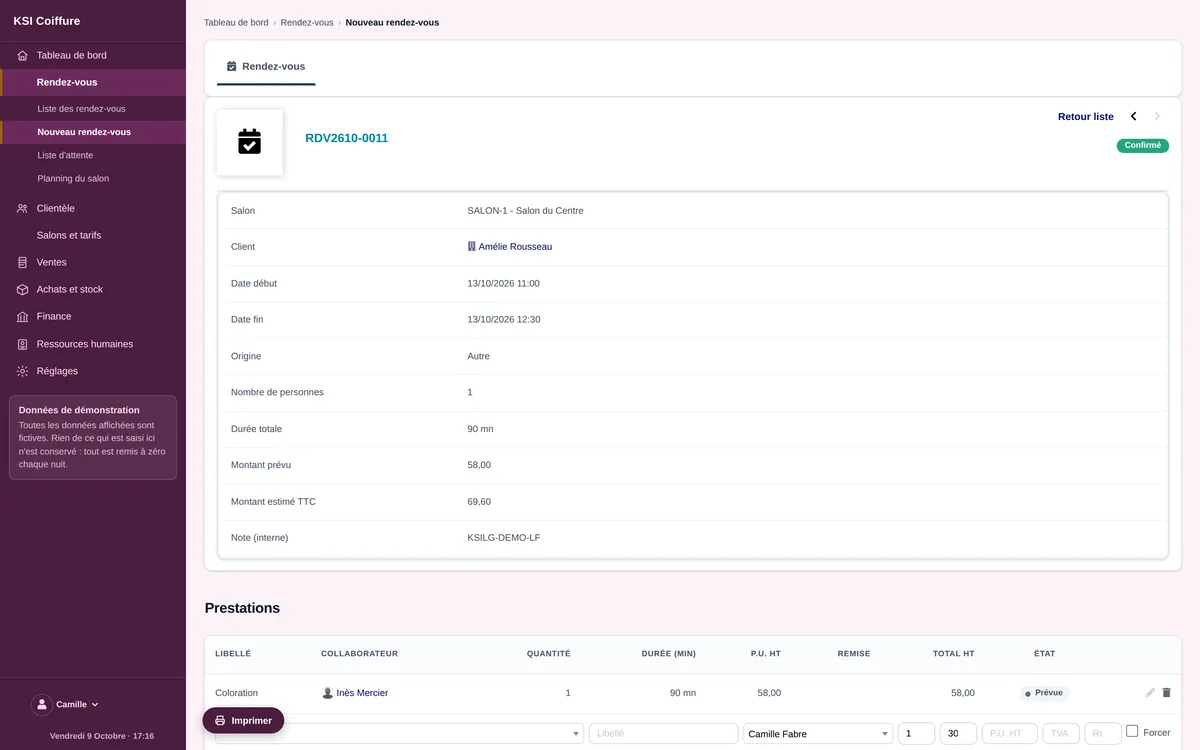
An appointment is taken from the customer’s record or from the schedule: the customer, the service, the stylist, the time. It moves through states you follow on screen — request, option, confirmed, arrived, in progress, done — and keeps the trace of a cancellation or a no-show. The schedule reads per salon and per stylist, for the day or the week.
Opening hours, absences and exceptional openings
You declare each salon’s opening hours, day by day, break included, then absences and exceptional openings. The schedule, online booking and the productivity calculation offer nothing beyond them: a slot outside opening hours does not exist.
Processing time, chairs and basins
A service can be split into phases: during processing time the chair stays occupied but the stylist is free for someone else. Chairs, basins, booths and devices are resources you declare; a phase can hold one without holding the person.
Customer records and consents
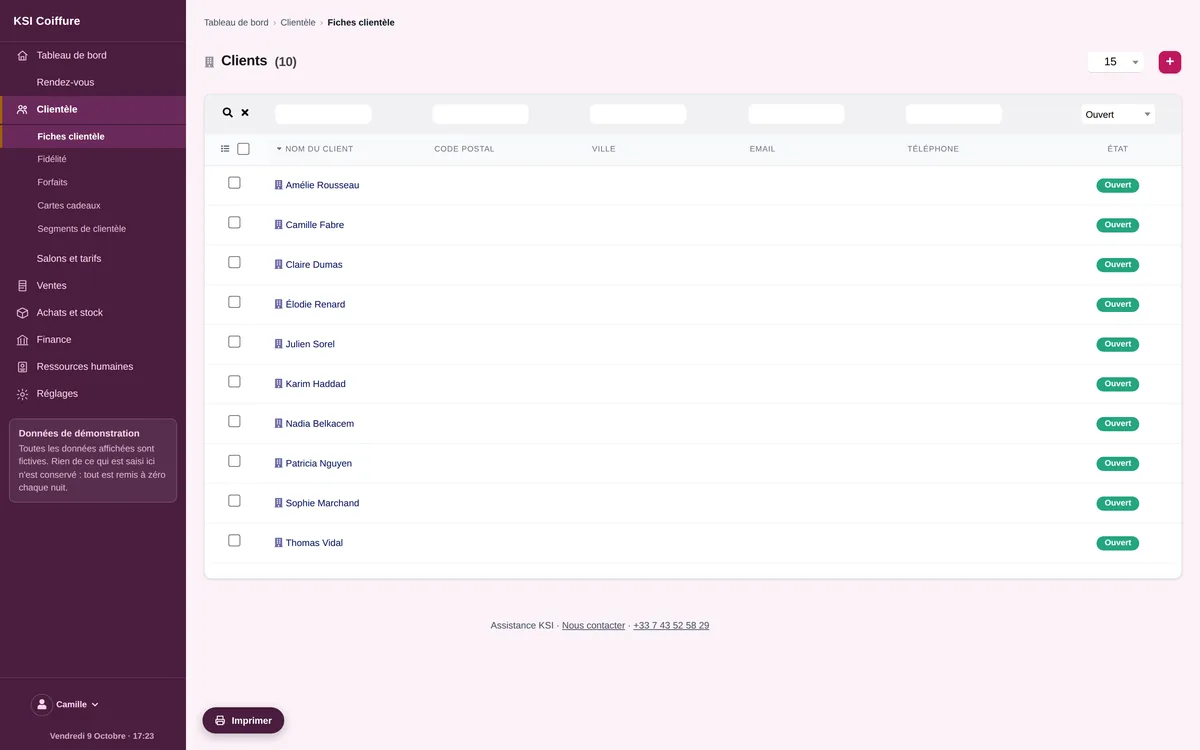
Each customer has a record: contact details, appointment history, preferences, and the consents she has given, recorded with their date. Before/after photos attach to the record and are only possible with a recorded consent.
Technical records
The technical record keeps, service after service, what you did: diagnosis, formulas, developer, processing time, remarks. The sensitivity test is recorded with its date and result, and its warning stays visible. The record prints to PDF.
Services, products and price list
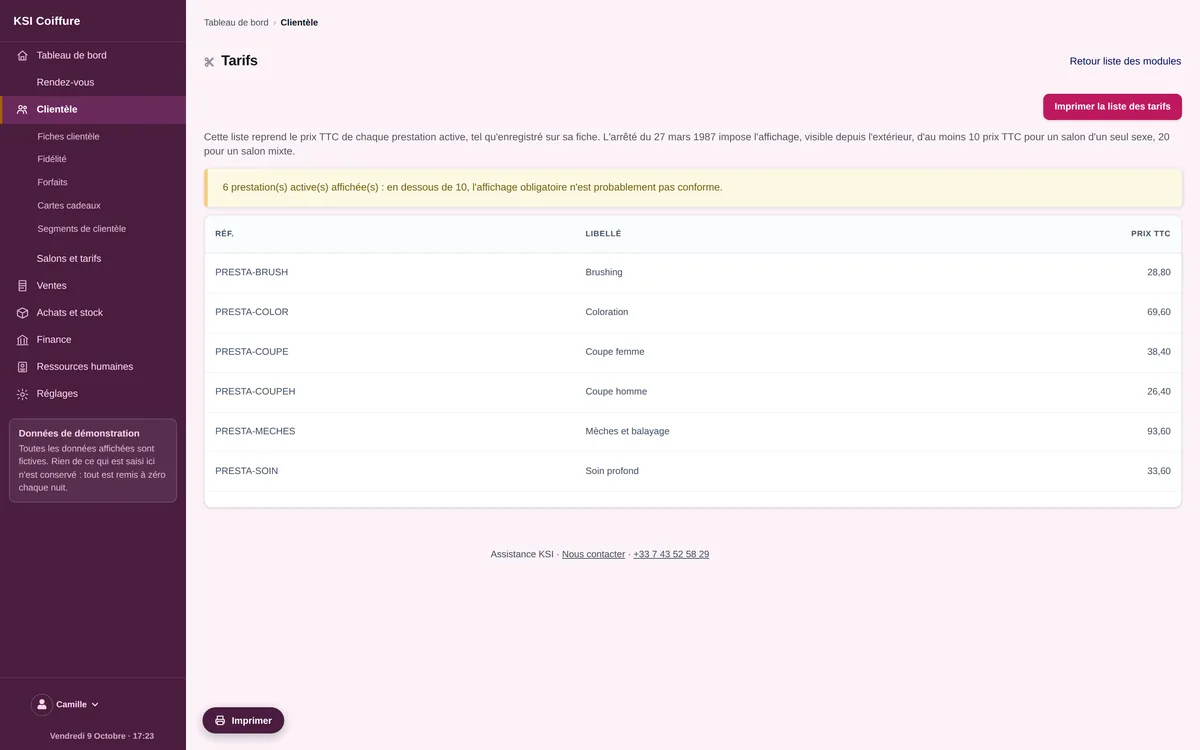
Services have a duration, phases and, where needed, a required skill. The products you resell are in the catalogue, and the technical products used by a service leave the stock. The price list reads on a single screen; a chain can set a price specific to one salon, and clearing the cell goes back to the general price.
Team, skills and commissions
Each stylist has skills, a schedule and absences. A service that requires a skill is not placed with someone who lacks it. Commissions are calculated per stylist on the appointment’s services, once its invoice is validated or paid — never on an intention.
Waiting list
A request you could not satisfy is remembered: the customer, the wanted service, the period, and whether another stylist would do. When an appointment is cancelled, its record tells you who was waiting for that slot. No message leaves on its own: the salon calls back.
Packages, gift cards and deposits
A prepaid package is a contract: what it contains no longer changes, each service used is written to a journal, and the balance is the difference between the two. A gift card is a bearer card: its code is never stored in clear and its balance is the sum of its movements. A deposit can be requested at booking and collected through native payments.
Loyalty, segments and reviews
Loyalty points are credited according to your rules and kept in a journal per customer. Customer segments say whom to contact — new customers, loyal customers, dormant customers, packages left to use — and rely on recorded consents; sending goes through mass mailing. After a service, the software asks for a review: it does not host it, display it or rate anyone.
Online booking
Your customers book themselves on your portal, with an account of their own: verified sign-up, password, history of their appointments. You choose whether a booking is confirmed automatically or by hand. A sign-up the software cannot match on its own to an existing record is submitted to you: you attach it, treat it as a new customer, or reject it.
Several salons and productivity
Several salons are managed within the same company, each with its schedule, its opening hours and, where needed, its prices. The productivity screen separates the occupancy of the station — the chair — from that of the person: processing time occupies one without occupying the other.
Quotes, invoices, payments and tamper-proof records
Quotes, invoices and payments are native: accounting, VAT and electronic invoicing work with no extra setting. An invoice is created from the appointment, with its services and the products sold. Entries are sealed and chained together: once recorded, an entry can no longer be changed, every correction goes through a reverse operation.
Frequently asked questions
Can I see the software before committing?
Yes. The demo is open to everyone, with no sign-up, with a fictitious salon already filled in: three stylists, services, customers, appointments over several months. It is reset every night.
Is my data kept separate from other salons’?
Yes. Each salon has its own instance and its own database. Nothing is shared between businesses.
Can my customers book online?
Yes, on your portal, with an account of their own: a booking is always in someone’s name, never anonymous. You decide whether it is confirmed automatically or after your approval, and the portal only offers the slots your opening hours allow.
What happens to technical records and sensitivity tests?
They stay in the customer’s record, in your database, and are used for nothing else. No follow-up segment is built on health data, and photos are only possible with a recorded consent.
Does the software handle several salons?
Yes. Each salon has its opening hours, its schedule and, if you want, its own prices; productivity reads salon by salon, station by station.
Can I bring over my customer file?
Yes, the migration is part of the setup: customers, services and price list. We assess it with you before announcing a date.